Disclosure: this page contains affiliate links. If you sign up through them we may earn a commission, at no extra cost to you. It does not change what we write.
The short answer. To start a wine cellar, buy fewer bottles than you think — twelve is enough — and choose each one by when it will be ready to drink, not by region or score. Spread them so something matures every two to three years: three bottles ready within a few years, four for ten to fifteen years out, three for fifteen to twenty-five, and two for the long end. Start with categories whose ageing is written into rules — Rioja Gran Reserva, vintage Champagne and Vintage Port — and keep the bottles cool, dark, still, on their side and at a stable temperature. Professional storage for a single case costs £10.80 a year at one UK merchant; the worked example below adds it up.
Most new cellars go wrong the same way: enthusiastic buying, eighty bottles within three years, two-thirds of them past their best before anyone noticed. Twelve deliberate bottles cost less, take less space and teach more. This plan assumes you are starting from zero and will drink the wine yourself rather than resell it.
The principle: drinking windows, not regions
Each bottle is bought with a rough sense of when it will be at its best — a few years, ten, twenty, occasionally thirty. With the right spread, a bottle reaches maturity every two to three years, so you learn what mature wine tastes like at intervals you can pay attention to. When you drink one, you replace it with a bottle at the same stage of its own life. Over three decades that builds a feel for ageing that reading cannot.
There are no prices on this page, deliberately: wine prices differ by market, tax status and vintage and move constantly. Price the structure from a merchant list in your own market on the day you buy.
The six categories
- Bordeaux, Left Bank
- Nebbiolo — Barolo or Barbaresco
- Rioja at the aged classifications
- Vintage Champagne
- Vintage Port
- A long-lived sweet or aromatic white — Sauternes, or German Riesling at Spätlese or Auslese level
Brunello, Northern Rhône, Napa Cabernet, Tokaji and Madeira would support the same architecture. This is one complete starter, not a complete list.
Three categories where the ageing rules are published
Most ageing advice is convention. Three of these six have their ageing set by a regulator or the official trade body, which makes them reliable places for a beginner to start. All quotations below were re-read on the bodies' own websites on 16 October 2026.
| Category | Published minimum | Source | What it means for your cellar |
|---|---|---|---|
| Rioja Crianza (red) | Two years' ageing, "at least one year in a 225 litre (49.5 gallons) oak barrels" | Consejo Regulador DOCa Rioja | Ready young |
| Rioja Reserva (red) | Three years, "at least 1 year in oak barrel plus a minimum ageing process of 6 months in bottle" | Consejo Regulador DOCa Rioja | Bottle age already done |
| Rioja Gran Reserva (red) | Five years, "2 of them in 49,5 gallon oak barrel plus 2 years in bottles" | Consejo Regulador DOCa Rioja | Mature on release — the easiest first bottle |
| Non-vintage Champagne | Maturation on lees "for at least 15 months" | Comité Champagne (champagne.fr) | Not a cellar bottle |
| Vintage Champagne | "At least 36 months in the cellar and often a good deal longer" | Comité Champagne (champagne.fr) | A mid-window cellar bottle |
| Vintage Port | "Bottled two to three years after the vintage", develops "for 10 to 50 years before it is drunk"; "the only Port that ages in bottle" | Instituto dos Vinhos do Douro e do Porto (IVDP) | The long end of the cellar |
That last line is why Vintage Port belongs at the far end of a thirty-year plan and nowhere else. And it is why a Gran Reserva belongs at the near end: years of ageing were done before it reached the shelf.
The twelve bottles, by window
| # | Bottle | Window from purchase | Why it is there |
|---|---|---|---|
| 1 | Rioja Gran Reserva | Ready now | Five years' statutory ageing before sale |
| 2 | Vintage Champagne with some age | Ready now | Shows how Champagne changes with time |
| 3 | Mature Bordeaux from a lighter vintage | Ready now | Mature Bordeaux at its most accessible |
| 4 | Barolo from a serious producer, strong vintage | 10–15 years | Nebbiolo turning from austere to supple |
| 5 | Left Bank cru bourgeois or minor classed growth, recent good vintage | 10–15 years | First real plateau in this window |
| 6 | Vintage Port from a recently declared year | 10–15 years, entering its window | IVDP's 10-year lower bound |
| 7 | A second bottle of 1, 2 or 3 from a different year | 10–15 years | Vintage variation, side by side |
| 8 | Left Bank classed growth, strong vintage | 15–25 years | The bottle that rewards patience most |
| 9 | Barbaresco from a top producer | 15–25 years | Approachable earlier than Barolo, long-lived |
| 10 | Sauternes or classified sweet wine (consider a half-bottle) | 15–25 years | Botrytised wine is among the longest-lived |
| 11 | A second Vintage Port, for the long end | 25+ years | Within IVDP's 50-year outer figure |
| 12 | German Riesling, Spätlese or Auslese, serious estate | 25+ years | Long-lived and usually good value for its lifespan |
Open the first three early. They calibrate your palate and tell you whether you like mature wine before the long-window bottles are locked in.
Worked example: what storing twelve bottles costs
You have three practical options: a small purpose-built wine cabinet, a genuinely cool and stable interior cupboard, or a professional store. Professional storage is the one with a published price. The Wine Society states its Members' Reserves storage charge is £10.80 per case per year (read 16 October 2026). Twelve 75cl bottles are one case:
| Period | Calculation | Cost at today's rate |
|---|---|---|
| One year | 1 case × £10.80 | £10.80 |
| Ten years | £10.80 × 10 | £108 |
| Thirty years | £10.80 × 30 | £324 |
Two caveats. Storage charges change over time, so treat the thirty-year figure as today's price multiplied out, not a forecast. And a professional store charges by the case, so ask how withdrawals work before you commit: getting one bottle out at a time is usually less convenient than a cabinet at home. Whether wine kept in bond or duty paid changes the tax position is explained in wine in bond versus duty paid.
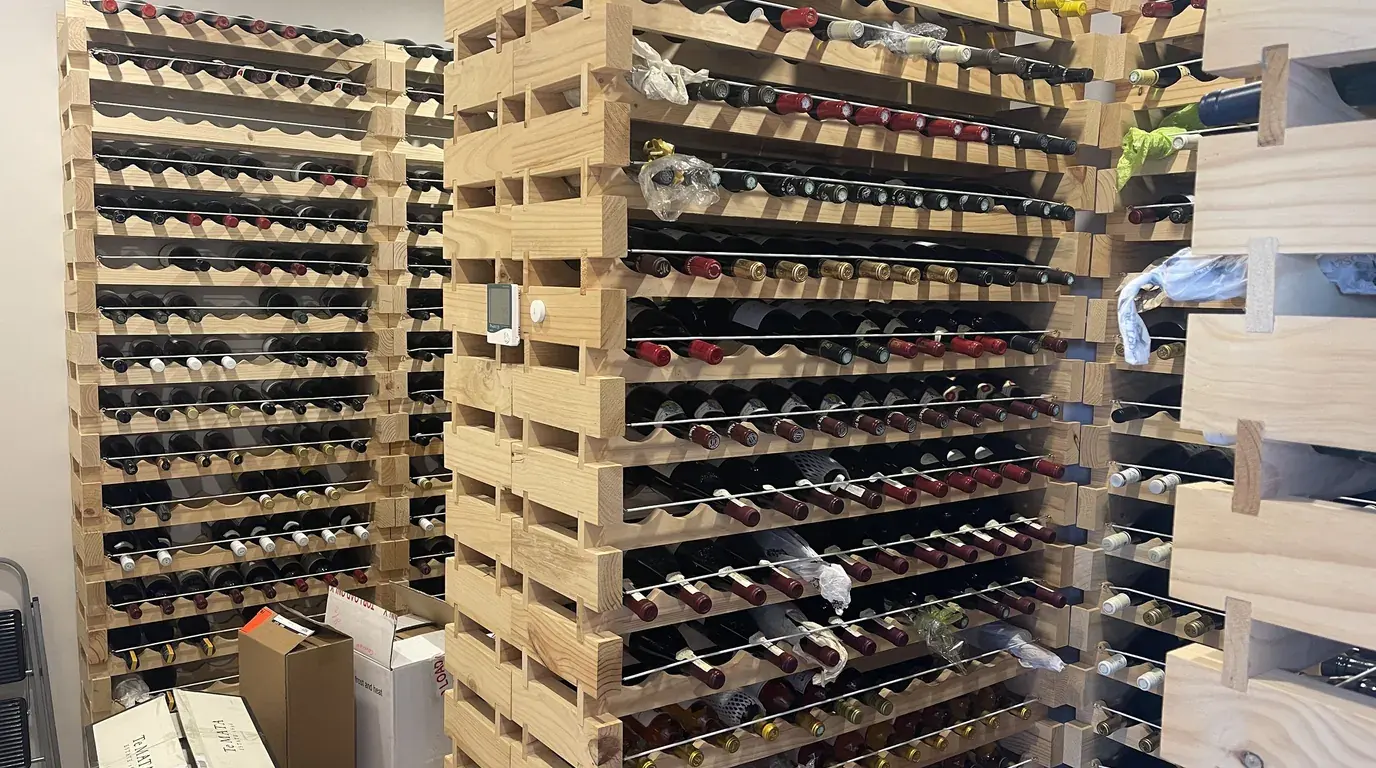
Storage at home: the part you cannot skip
- Cool and stable. Stability matters more than a precise number; a cupboard that stays steady all year beats a cellar that swings with the seasons.
- Moderate humidity. Too dry and corks shrink; too damp and labels rot, which costs money at resale even if the wine is fine.
- Dark. No daylight on the bottles.
- Still. Not on an appliance or against a boiler.
- On their side, so the cork stays wet.
A heated basement, a kitchen cupboard next to the oven, and a garage anywhere with real seasons are all the wrong answer. The full treatment is in how to store fine wine properly and the wine storage guide.
What the cellar teaches, in order
- Early years: what bottle age does to a wine sold mature, and how aged Champagne differs from young.
- Around ten years: Nebbiolo softening; young and older Bordeaux compared directly.
- Around fifteen: botrytised wine at its first plateau, if you bought the half-bottle.
- Around twenty: a serious Bordeaux from a serious year — the lesson the plan is built around.
- Twenty-five and beyond: Vintage Port and aged Riesling doing what they were made for.
What this cellar is not
It is not an investment. At this scale you will not make meaningful money even if every bottle rises sharply; buy it to drink. An investment position needs different bottles, volumes and storage — start with the rare wine investment guide, and for buying older bottles, how to buy wine at auction and what fill levels mean.
It is not exhaustive. Whole great regions are missing on purpose.
It is not a display. A cellar that exists to be photographed is unopened bottles serving the wrong purpose.
The counter-argument
Thirty years is a long time to commit to choices made by a version of you who barely knows the subject. Tastes change; the bottle saved for 2050 may be from a category you stopped caring about in 2032. The answer is built into the structure: the early tier exists so you learn what you like before the long-window bottles are fixed. If Port turns out not to be for you, drink it young, sell it or give it away, and fill the slot with something you have since discovered. The architecture is the point; the bottles are replaceable.
Frequently asked questions
How do I start a wine cellar from scratch?
Buy about twelve bottles chosen by drinking window — three ready now, four for ten to fifteen years, three for fifteen to twenty-five and two for the long term — and store them cool, dark, still, on their side and at a stable temperature.
How many bottles should a starter wine cellar have?
Twelve is enough. It is one case, takes little space, and spread across drinking windows it gives you a bottle reaching maturity every two to three years.
Which wines have ageing rules set by law or the trade body?
Rioja (Crianza two years, Reserva three, Gran Reserva five, per the Consejo Regulador), Champagne (non-vintage at least 15 months on lees, vintage at least 36 months in the cellar, per the Comité Champagne) and Vintage Port (bottled two to three years after the vintage, then 10 to 50 years in bottle, per the IVDP).
How much does it cost to store wine professionally?
It varies by provider. The Wine Society, for example, charges £10.80 per case per year for Members' Reserves, so a twelve-bottle case costs £108 over ten years at today's rate.
Is a starter cellar a good investment?
No. At twelve bottles the sums are too small to matter even if prices rise; buy it to drink and to learn how wine ages.